

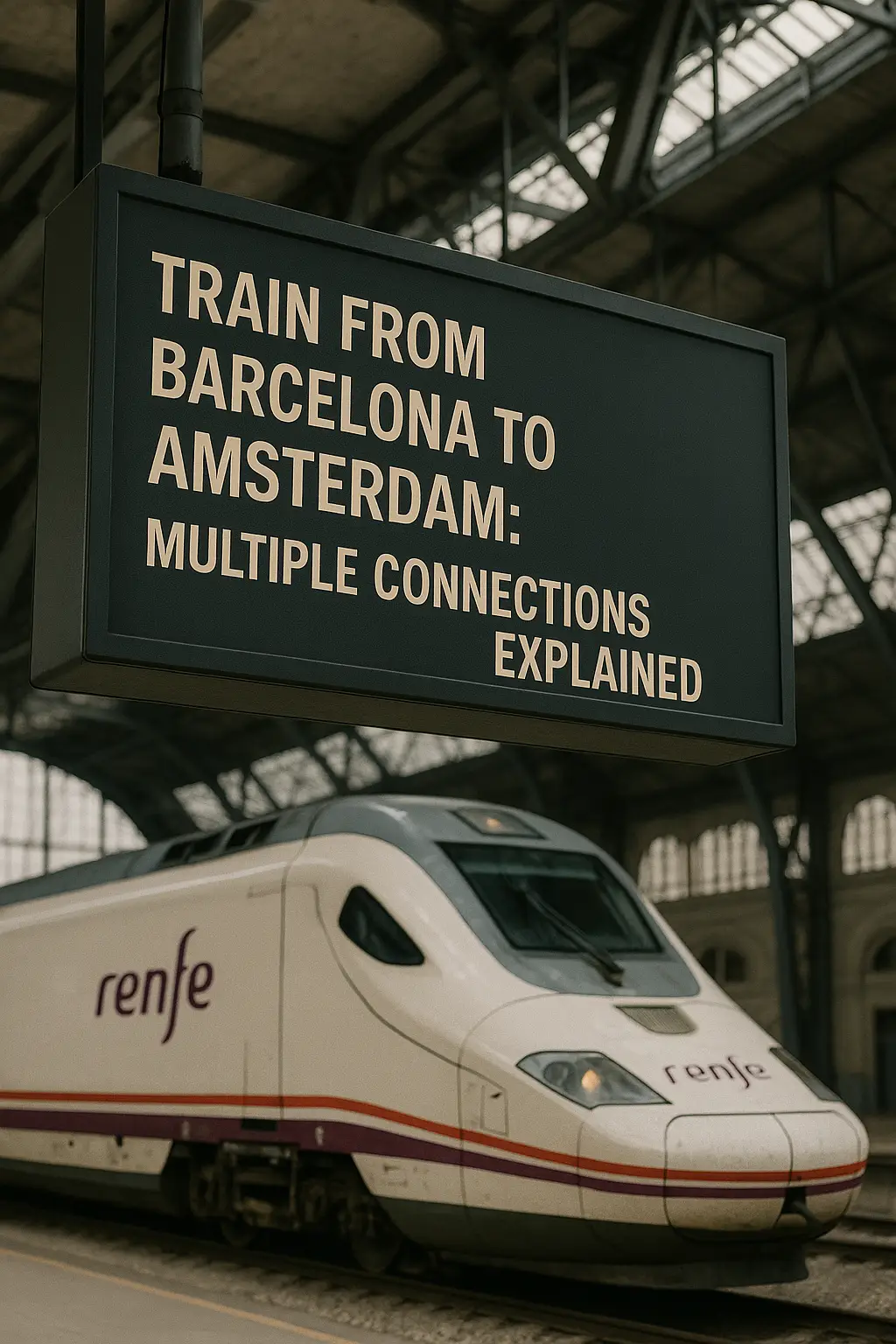
I once did Barcelona to Amsterdam by train on a gray Tuesday in late autumn. Coffee at Sants before sunrise. A croissant that shed flakes everywhere. By midnight I was leaning on a hotel window in the Jordaan watching bikes glide past in the drizzle. Long day, yes. Tiring in parts. Worth it, very much. The route is not a single line on a map. It is a set of smart hops. If you pick the right joins, the journey feels like a mini tour through Spain and France with a fast final dash into the Netherlands.
Below is a friendly breakdown of how the trip works right now. Clear steps, realistic timings, and small tricks that saved me time and nerves.
The big picture in one minute
-
There is no direct Barcelona–Amsterdam train.
-
The fastest pattern uses two or three connections through France.
-
Typical travel time sits around 11 to 13 hours door to door.
-
The most common chain: Barcelona Sants → France (Lyon or Montpellier or Paris) → Paris Gare du Nord → Amsterdam Centraal.
-
Book early. High-speed seats sell in price waves.
Key building blocks
1) Barcelona Sants → Southern France or Lyon
Renfe runs AVE high-speed trains from Barcelona into France. Two useful routes:
-
Barcelona → Lyon Part-Dieu
Smooth run across the border via Figueres and Valence. Comfortable seats. Power sockets. A calm crowd. -
Barcelona → Marseille route with stops at Perpignan, Narbonne, Béziers, Montpellier, Nîmes, Avignon
Great if you plan to connect at Montpellier or Nîmes for a northbound TGV.
I like the Lyon option because the station is a solid hub and connections feel organized. Montpellier also works for tight schedules and has easy platforms.
How long
Around 5 hours to Lyon, less to Montpellier.
Booking tip
Check Renfe for the Spain→France leg. Sometimes SNCF displays the same seats under a different code, yet the price windows match close enough. Early tickets can be kind.
2) South or East France → Paris or Lille
From Lyon Part-Dieu a TGV INOUI jumps to Paris Gare de Lyon in about 2 hours on a good run.
From Montpellier or Nîmes a TGV also heads north to Paris Gare de Lyon.
You can also ride Lyon → Lille Europe on some schedules. Lille gives a less stressful cross-station change because Lille Europe and Lille Flandres sit close. Nice plan if Paris feels crowded for you.
Why this middle step matters
This is the bridge into the Paris–Amsterdam high-speed line. A clean on-time arrival here makes the rest easy.
3) Paris transfer: Gare de Lyon → Gare du Nord
If your train lands at Gare de Lyon, the final dash to Amsterdam starts at Gare du Nord. They are across town yet connected by RER D and RER A/B. A taxi also works when bags multiply.
Plan at least 60–75 minutes for the cross-city change. I add a coffee stop cushion. Paris stations in December feel magical and busy at the same time.
Micro steps that help
-
Follow the big white RER signs downstairs at Gare de Lyon.
-
Ride RER D toward Gare du Nord. The ride is short.
-
Keep your onward ticket handy because gates need a scan on exit.
4) Paris Gare du Nord → Amsterdam Centraal
The red Thalys brand merged into Eurostar on this high-speed axis. The train is still the same fast ride with a new name on the seatback. Paris to Amsterdam takes about 3 hours 20 minutes with stops in Brussels and Rotterdam. Wi-Fi, power, and a steady café bar make this last stretch pass fast.
Arriving
Amsterdam Centraal drops you right by the canals. Trams wait outside. If bags are heavy, walk ten minutes and the city opens up.
Three real itineraries that work
Times change by season, so think in blocks rather than exact minutes. Here are patterns that rarely fail.
A) The “Lyon bridge”
-
Morning: Barcelona Sants → Lyon Part-Dieu on AVE
-
Midday: Lyon Part-Dieu → Paris Gare de Lyon on TGV
-
Late afternoon: Cross to Gare du Nord
-
Evening: Paris → Amsterdam on Eurostar
Why I like it
Two high-speed legs with one clean city transfer. Lyon station food is decent. The whole day flows.
B) The “Montpellier dash”
-
Early morning: Barcelona Sants → Montpellier St-Roch on AVE
-
Midday: Montpellier → Paris Gare de Lyon on TGV
-
Afternoon: Paris cross-town transfer
-
Evening: Paris → Amsterdam
Why it wins
Shorter first leg. Montpellier station is compact, so platform changes feel easy even with luggage.
C) The “Lille soft landing”
-
Morning: Barcelona → Lyon on AVE
-
Midday: Lyon → Lille Europe on TGV
-
Afternoon: Walk to Lille Flandres or wait at Europe
-
Later: Lille → Amsterdam on a direct Eurostar
Why try this
Avoids Paris cross-town. Lille stations sit close. The city center has quick snacks right at the square.
Seats, luggage, and prices in plain words
-
Classes: Standard or Comfort on Eurostar. TGV and AVE add First options. Standard already feels fine.
-
Luggage: No formal check-in. Carry on to the racks above or at coach ends. Large suitcases fit upright on the big racks.
-
Seats: Pick a duo if traveling as a pair. Solo travelers often prefer the 1-across side in First for quiet.
-
Prices: Barcelona→France leg varies a lot by date. Paris→Amsterdam also moves in tiers. Early birds get nicer numbers.
-
Rail passes: Eurail or Interrail passes cover the distance yet seat reservations remain mandatory on high-speed legs and cost extra. Add that math before deciding.
How I plan a no-stress day
-
Pick the middle anchor first. I choose a Eurostar from Paris to Amsterdam that lands before 22:00.
-
Work backward from that time to select the Lyon or Montpellier arrival into Paris with at least a 75-minute buffer.
-
Book the Barcelona→France leg that hits the chosen city with an hour to spare for snacks or a quick stretch.
-
Save tickets to the phone wallet and also as PDFs in a notes app. Train Wi-Fi sometimes blocks email logins.
-
Pack cables and a small power bank. Seats have plugs, yet a backup feels smart.
Food and coffee along the way
-
Sants: croissants, tortilla, coffee that wakes you up.
-
Lyon Part-Dieu: grab a baguette and fruit. Easy kiosks by the board.
-
Paris Gare de Lyon: the Hall 1 concourse has decent options and a calm upstairs spot for a longer sit.
-
Gare du Nord: quick coffee and a pastry before boarding. The platform staff move fast, so keep an ear on announcements.
Common “gotchas” and easy fixes
-
Tight Paris transfer
If the first train arrives late, head straight to the RER level. Staff can point you to the fastest platform. Eurostar staff often rebook late connections, yet give yourself margin to avoid that line. -
Wrong side of the street pickup
In Lyon and Montpellier some taxi stands sit across from the main exit. Check the pictograms above the doors. -
Seat at a table facing backward
If motion sensitive, pick a forward-facing seat during booking. On some trains the app shows carriage direction. -
Winter weather
High-speed lines handle cold well. Snow days still happen. Keep one flexible hotel reservation in Paris or Lyon if you travel in deep winter.
Quick comparison with plane
Flying takes less time in the air yet adds the airport layers. The train gives space, a view, and a lower stress rhythm. Carbon impact sits lower too. I like the train on any trip where the total door-to-door time stays under 12–13 hours. Barcelona to Amsterdam sits right within that band.
Final thoughts
The Barcelona to Amsterdam train is a grown-up adventure that still feels simple. One country for breakfast, another for lunch, canals by night. Choose your anchor in Paris or Lille, stack the legs with a calm buffer, and let high-speed lines stitch the map together. I started the day with that flaky croissant at Sants and ended it with rain beads on a Dutch window. Same day, two moods. That mix is why I keep riding.
You may also like:
FAQs
How many connections are usual from Barcelona to Amsterdam?
Two or three. One inside France, then Paris or Lille to Amsterdam. The smooth pattern is Barcelona → Lyon or Montpellier → Paris → Amsterdam.
How long does the full journey take?
Around 11 to 13 hours in one day when connections line up. Add a night in Lyon or Paris if you prefer a softer pace.
Which stop is best for the change in France?
Lyon Part-Dieu for a stable hub. Montpellier St-Roch for a compact station and short walks. Both work well.
Is the Paris cross-city transfer hard?
It is direct on the RER and takes minutes once on the train. Allow at least an hour for ticket checks, lifts, and crowds.
Can I split the trip and stay a night?
Yes. A Lyon evening with dinner or a Paris stopover turns the journey into a tiny city break.
Are seat reservations required with a rail pass?
Yes on AVE, TGV, and Eurostar. Pay the reservation fee when you plan your legs.
What about luggage limits?
No formal weight checks on these trains. Keep bags you can lift to the rack. A small lock for peace of mind is handy.
Any scenic parts worth a window seat?
Yes. The run between Perpignan and Montpellier shows the sea and lagoons. Approaching Rotterdam and crossing rivers into the Netherlands also looks great.
