

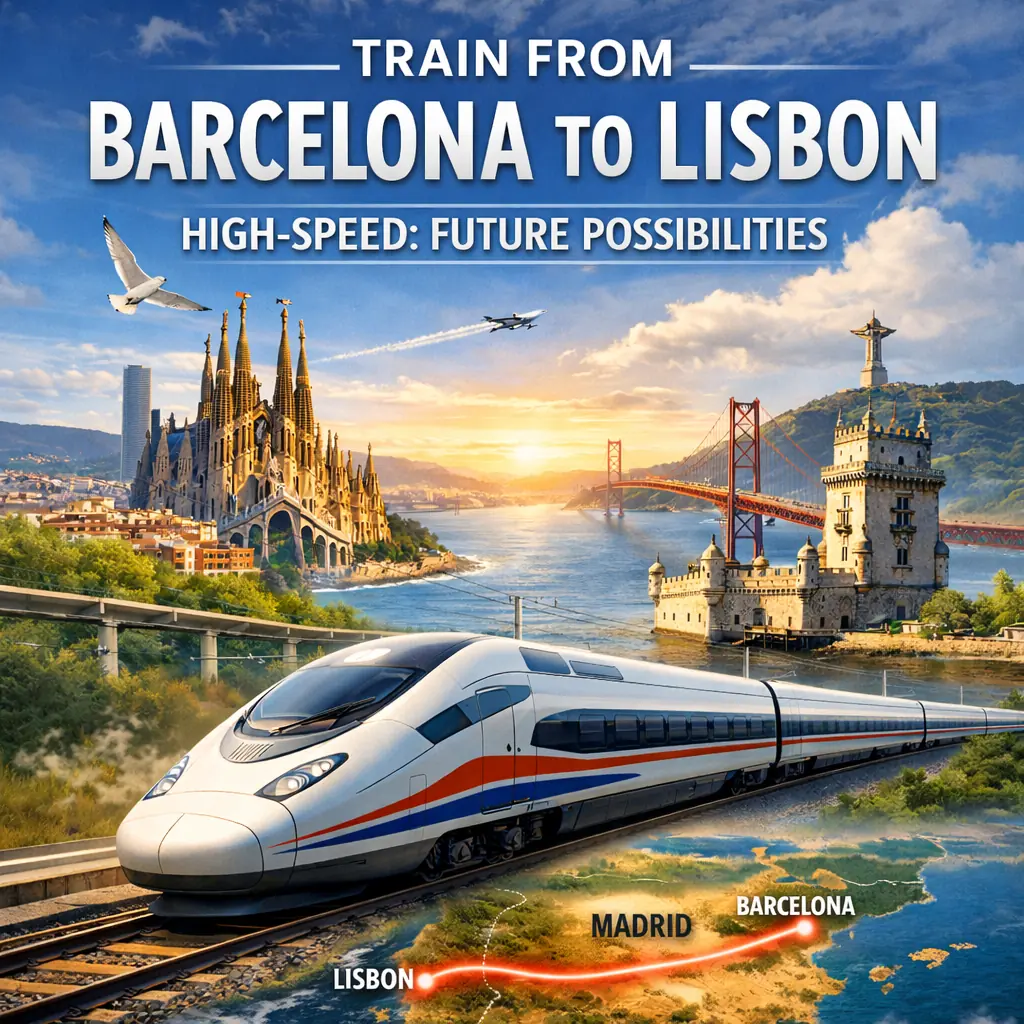
I have a little travel habit. Whenever I land in a new city I open Maps and check how far the next city is by train. Not because I always take trains. More because trains feel like the most relaxed version of travel. No airport shuffle. No tiny shampoo rules. Just you, a seat, a window and a slow moving change of scenery.
So when people ask about a high-speed train from Barcelona to Lisbon, I get why the idea feels so exciting. Barcelona and Lisbon are both big hitters. Food, viewpoints, neighborhoods that keep pulling you outside. And yet the connection between them still feels awkward compared to how close they are on the map.
Right now, the “high-speed” part is mostly a future story. But it is not fantasy. It is more like a slow build that depends on a few key pieces lining up.
Let me explain it in a simple way, like we are chatting over coffee.
Why a high-speed Barcelona to Lisbon train still feels tricky today
Barcelona has strong fast rail. Lisbon has good rail too, but the fast corridor between Spain and Portugal has never felt fully stitched together for passengers. So the trip becomes a mix of options. One fast leg. One slower leg. Sometimes a bus. Sometimes a long wait.
That is why people keep wishing for one smooth route that feels modern and easy.
A real high-speed connection needs three things:
-
A fast backbone between Madrid and Lisbon
-
Easy transfers that do not feel stressful
-
Tickets that are simple to buy in one go
Barcelona already connects well to Madrid. The missing magic is the Madrid to Lisbon side. Once that becomes fast, Barcelona to Lisbon starts making sense in a big way.
You may also like:
The realistic “future route” most people will use first
When people imagine a direct train, they often picture one train from Barcelona to Lisbon. That might happen later. The first version that feels truly usable will probably be this:
Barcelona → Madrid → Lisbon
That sounds like a compromise. In real life it can feel smooth if the schedules are friendly and the stations are set up for it. Madrid is built for rail connections. Barcelona is used to fast departures. So the only thing that needs to level up is the Madrid to Lisbon speed and reliability.
In other words, the future high-speed dream is basically a Madrid–Lisbon upgrade that Barcelona can plug into.
What “high-speed” could mean for travel time
People love a single number. Like tell me the exact hours. But future rail time depends on engineering, borders, track upgrades, and how many stops the service makes. Still, it is possible to picture a few believable scenarios.
Scenario 1: A “good enough” fast connection
If Madrid to Lisbon becomes a lot faster than it is today, Barcelona to Lisbon could land in the range where trains become a real choice for normal travelers. Not only rail fans.
In that scenario the total trip might feel like:
-
Barcelona to Madrid: fast and frequent
-
Madrid to Lisbon: faster than before
-
A transfer in Madrid that is not painful
So the day becomes: leave after breakfast. arrive by evening. Still a full travel day but not a nightmare day.
Scenario 2: A “wow” connection
This is the version that changes habits. The version where people start saying, why would I fly.
If Madrid to Lisbon becomes truly high-speed, and Barcelona to Madrid stays fast or gets even faster, then Barcelona to Lisbon could drop into the range that feels competitive for many trips. You lose time at airports. Trains leave from city centers. That matters.
When a train trip feels clean and predictable, people forgive a few extra minutes. They will take the easier experience.
Direct train vs one-transfer train: what is more likely first
Let’s separate this clearly.
Option A: One easy transfer in Madrid
This is the most likely first step because it uses an existing pattern. Spain’s high-speed network already funnels through Madrid. If the Madrid–Lisbon service becomes strong, the Barcelona–Lisbon trip becomes a simple connection.
This is the version that can scale quickly.
Option B: One train with no change
This is possible later if demand is strong. Rail operators love direct routes when they fill seats. But direct routes need clean cross-border operations and the right rolling stock and timetable planning. That takes time.
So if someone asks me what arrives first, I would bet on the Madrid transfer being the “first real high-speed feeling” option.
You may also like:
-
Flight from Lisbon to Barcelona vs. Train: Compare Time and Price
-
How to Get from Barcelona to Lisbon by Train: Iberian Adventure
Why this corridor matters for the whole Iberian vibe
A fast Barcelona–Lisbon rail experience is not only about two cities. It changes how people travel around the peninsula.
Think about it:
-
Weekend Lisbon trips from Barcelona become more realistic
-
Multi-city routes become easier, Barcelona to Madrid to Lisbon to Porto
-
Tourists who hate flying start choosing rail more often
-
Families can travel without the airport stress
Also it spreads travel money around. People stop in places they used to skip. Even one extra night in Madrid on the way can become part of the trip, not a hassle.
What might slow it down
I will be honest. Big rail projects move like slow ships. Even when everyone agrees.
Here are the usual speed bumps:
-
Cross-border coordination and approvals
-
Construction timelines that shift
-
Funding phases that stretch
-
Politics changing priorities
So it is smart to view “future high-speed” as a gradual upgrade story. First improvements. Then better timetables. Then the smooth booking experience. Then maybe direct services.
Signs that the future is actually arriving
If you want to spot the shift before the headlines, watch for these things:
1) Better Madrid–Lisbon schedules
When rail options become frequent and fast, that is the main sign.
2) Seamless ticket booking
The moment you can book Barcelona to Lisbon in one clean checkout, normal travelers start trusting it.
3) Timed connections in Madrid
When operators design schedules around connections, the trip feels intentional. Not improvised.
4) More talk about rail alternatives to flying
When tourism boards and travel media start presenting the train as the default option, the change is close.
My honest take as a traveler
A high-speed Barcelona to Lisbon train makes perfect sense. The cities match. The demand is there. The climate-friendly angle is a bonus too.
But I think the first “great” experience will be a one-transfer journey via Madrid. That is still a win. People already connect in big European hubs all the time. If the transfer is easy, it counts.
The direct Barcelona–Lisbon train feels like a second chapter. It comes after the corridor is proven. After passenger numbers look strong. After the operations feel stable.
So the future possibilities are real. The only frustrating part is the waiting.
You may also like:
FAQs
1) Is there a high-speed train from Barcelona to Lisbon right now?
No direct high-speed service exists right now. The trip usually involves multiple legs and planning.
2) What is the most realistic future high-speed route?
Barcelona to Madrid on fast rail, then Madrid to Lisbon on an upgraded faster service. One transfer. Two strong legs.
3) Will a direct Barcelona to Lisbon train happen?
It could. Direct services often appear once demand is proven and operations become simple across borders.
4) When will the trip start feeling competitive with flying?
When the Madrid–Lisbon segment becomes much faster and connections become smooth. Airports add time and stress. A clean rail trip can win even if it is not the absolute fastest minute on paper.
5) What should I watch for if I want updates?
Look for news about the Madrid to Lisbon rail corridor, new cross border timetables and ticketing changes that allow one booking from Barcelona to Lisbon.
6) What is the best option today if I still want to try rail?
A popular approach is Barcelona to Madrid by high-speed, then plan the Portugal leg separately. It can be done. It just requires patience and flexible timing.
