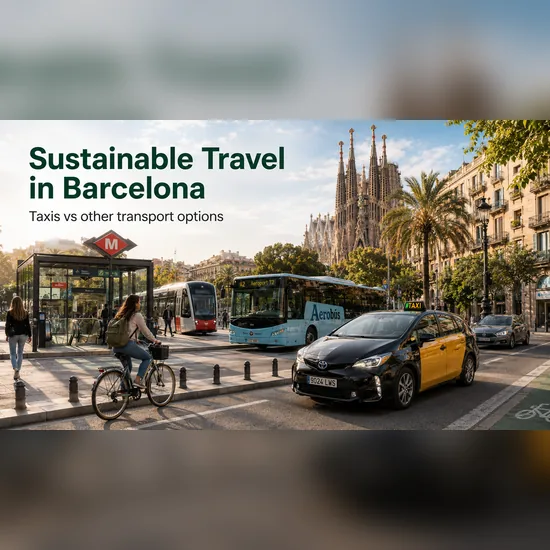
Barcelona is a city that naturally fits sustainable travel. It is compact, walkable, well connected by public transport, and increasingly attractive to travellers who want to reduce their environmental impact. Still, once people land at the airport or start moving between hotels, attractions, meetings, and day-trip locations, the same question appears again and again: what is the most sustainable way to travel in Barcelona? And so lets discuss sustainable transport Barcelona options in detail.
The answer is not always as simple as choosing the cheapest ride or the fastest route. Sustainability depends on several things at once: the type of vehicle, how many passengers are travelling together, how far the journey is, and whether the trip is direct or involves extra connections. A metro ride usually has a very low footprint per passenger. An airport bus can also perform well when many people are on board. A private petrol car used by one person tends to have a much higher impact. Taxis and private transfers sit somewhere in the middle, but the result changes a lot depending on whether the vehicle is standard, hybrid, or electric.
This matters more than ever in sustainable transport Barcelona 2026 searches. Modern travellers are not only looking for comfort. They are also looking for better choices. They want to know whether public transport is always the greenest option, whether a taxi is automatically worse, and whether a low-emission private transfer can actually be a responsible alternative. In many situations, it can.
Book your Airport Transfer Barcelona and Taxi Barcelona from TAXXILO.COM.
Why Sustainable Travel in Barcelona Matters
Barcelona attracts millions of visitors every year. Tourism, airport transfers, city travel, and day trips all create transport demand. If every traveller depends heavily on high-emission transport, the environmental cost rises quickly. On the other hand, when people choose efficient low-emission options, the city becomes cleaner, quieter, and easier to enjoy.
That is why sustainable travel is not only about protecting the environment in theory. It is also about the real visitor experience. Cleaner transport contributes to better air quality, less congestion, and a smoother urban environment. For eco-conscious travellers, this turns transport from a simple necessity into part of a smarter travel plan.
Estimated Carbon Footprint by Transport Type
The table below gives approximate CO₂ per passenger-kilometre to help compare the most common ways of getting around Barcelona. These are broad practical estimates meant for easy comparison, not exact trip-by-trip measurements.
| Transport Option | Estimated CO₂ per passenger-km | Best For |
|---|---|---|
| Walking | 0 g | Very short city trips |
| Cycling | 0 g direct emissions | Short and medium local journeys |
| Metro | 20–35 g | Solo travellers and central city routes |
| Aerobus | 30–50 g | Airport to key city stops |
| Hybrid taxi / hybrid transfer | 45–90 g | Door-to-door travel with lower emissions |
| Electric private transfer | 20–60 g | Low-emission private transport |
| Standard taxi | 100–150 g | Direct trips when convenience is priority |
| Private petrol car | 150–200 g | Flexible travel but usually highest impact per passenger |
The main lesson is simple: occupancy changes everything. If one person sits alone in a petrol car, emissions per passenger remain high. If four travellers share one hybrid or electric transfer, the footprint per person drops significantly. This is why group travel can completely change the sustainability picture.
Metro: Usually the Lowest-Carbon Motorised Option
For many city journeys, the Barcelona metro is one of the strongest choices. It moves large numbers of passengers efficiently and is ideal for common routes between central neighbourhoods such as Eixample, Gràcia, Sants, El Born, and Poblenou. If your hotel is near a station and you are carrying only light luggage, the metro is usually the most efficient low-carbon option.
The metro works especially well for solo travellers and couples who want an affordable and practical way to get around the city. It avoids road traffic and makes it easy to travel without adding more vehicles to already busy streets.
Still, the metro is not perfect for every situation. If you are arriving after a long flight, travelling with children, carrying large suitcases, or reaching accommodation far from a station, the convenience gap becomes obvious. A transport option can have a lower carbon footprint on paper while still being difficult in real life.
Aerobus: A Good Sustainable Option for Airport Travel
Aerobus is a solid option for many visitors arriving at Barcelona Airport. It provides a direct link between the airport and major city points, which makes it attractive for travellers heading to central areas. Because it carries many passengers at once, the emissions per person are often lower than a single-occupancy car or a standard taxi.
For travellers staying close to the main stops, Aerobus can be an excellent combination of affordability and lower environmental impact. It is especially useful for people who are comfortable managing their own luggage and do not mind a short walk or a second connection afterward.
However, it is not a complete solution for everyone. Many visitors still need another ride after leaving the airport bus, especially if they are staying in residential areas, apartments, or hotels away from the main route. In those cases, the total journey becomes less direct and sometimes less practical.
Private Car: Flexible but Usually the Highest Impact
A private car gives freedom, but inside Barcelona it is often the least sustainable choice, especially when used by one traveller or a couple only. The city already offers many transport alternatives, so driving a private petrol car for urban trips often creates more emissions than necessary.
There are also practical downsides. Parking stress, city traffic, and limited need for a car inside central Barcelona reduce its value for many visitors. For eco-conscious travellers, hiring or using a private combustion car is rarely the strongest option unless the journey involves places far outside the city where public transport is limited.
Where Taxis Fit in the Sustainability Conversation
Taxis are often judged too quickly in sustainability discussions. People sometimes assume a taxi is always a bad environmental choice. The reality is more nuanced. A standard fuel taxi used by one person may indeed have a higher footprint than the metro or airport bus. But taxis also solve a real transport need: direct pickup, no extra connections, luggage support, and time efficiency.
The sustainability of a taxi trip improves when more passengers share the vehicle and when the car itself is cleaner. A hybrid taxi is a very different option from an older high-emission car. This is where travellers need to look beyond the simple label of “taxi” and think instead about vehicle type plus passenger count.
Why Hybrid and Electric Taxxilo Vehicles Make Sense
This is the point where Taxxilo becomes relevant in a meaningful way. The goal is not to pretend that private transport should replace walking, cycling, or the metro. Public transport remains a smart choice for many routes. But there are many situations where travellers genuinely need a private ride. In those moments, the smartest question becomes: what is the greenest private option available?
That is where hybrid and electric Taxxilo vehicles stand out.
For families, airport pickups, business travellers, hotel transfers, and passengers with luggage, a low-emission private transfer can be the most balanced choice. It offers direct door-to-door service without the higher footprint of a typical petrol car. It also reduces the stress of changing between different transport modes after a flight or during a busy travel day.
An electric or hybrid Taxxilo vehicle can be the greenest private option because it combines convenience with lower emissions. When shared by two, three, or four passengers, the environmental performance becomes even stronger. Instead of thinking only in terms of taxi versus metro, it is better to think in terms of which option gives the best mix of low emissions, comfort, and practical value for the specific trip.
Best Sustainable Choice by Travel Situation
Solo traveller in the city centre
If you are travelling alone and staying near metro access, the metro is usually the best low-carbon choice.
Airport traveller with light luggage
Aerobus is a good option if your destination is close to one of its main stops.
Family with children and suitcases
A hybrid or electric Taxxilo transfer is often the better option because the journey stays direct, smooth, and more efficient per passenger than many people expect.
Business traveller on a schedule
A low-emission private transfer makes sense when reliability, punctuality, and door-to-door convenience matter.
Late-night arrival
A pre-booked hybrid or electric transfer is often the most practical and responsible choice when public transport options become limited.
How to Reduce Your Travel Footprint in Barcelona
Sustainable travel in Barcelona does not mean choosing one transport method for everything. It means matching the right option to the right journey.
Walk whenever the distance is short. Use the metro for easy urban trips. Choose Aerobus when your destination fits its route. Book a hybrid or electric private transfer when comfort, luggage, timing, or direct access matter more. If possible, travel together rather than separately. One efficient shared ride is often better than several disconnected journeys.
This approach is more realistic than extreme all-or-nothing thinking. Most travellers want to be responsible, but they also want their trip to run smoothly. Barcelona makes that balance possible.
Final Thoughts
If your goal is to travel sustainably in Barcelona in 2026, the smartest choice depends on the type of journey. The metro remains one of the best low-carbon options for everyday city movement. Aerobus is a strong solution for many airport arrivals. A private petrol car is usually the weakest option from an environmental point of view. Standard taxis sit in the middle, but cleaner vehicle types change the picture.
For travellers who need private transport, hybrid and electric Taxxilo vehicles offer the best private balance between comfort and sustainability. They allow you to keep the convenience of door-to-door travel without relying on a higher-emission option. That makes them a smart fit for eco-conscious travellers who still value time, ease, and reliability.
In the end, sustainable travel in Barcelona is not about making your trip harder. It is about making it smarter.
Book your Airport Transfer Barcelona and Taxi Barcelona from TAXXILO.COM.
FAQs
What is the most sustainable transport option in Barcelona?
Walking and cycling are the most sustainable for short distances. For motorised transport, the metro is usually the lowest-carbon option for city travel.
Is Aerobus more eco-friendly than a taxi?
For a solo traveller going to a central stop, Aerobus is usually the greener option. For a group or family needing direct hotel drop-off, a hybrid or electric private transfer can be a very strong alternative.
Are taxis bad for sustainable travel in Barcelona?
Not always. Standard taxis have a higher footprint than public transport, but hybrid and electric taxis are much better. The number of passengers also makes a big difference.
Is a private car less sustainable than a taxi?
In many cases yes, especially if the private car is petrol and used by one person. Shared low-emission private transfers can be more efficient per passenger.
What is the greenest private transport option in Barcelona?
A hybrid or electric private transfer is usually the greenest private option, especially when the ride is shared by multiple passengers.